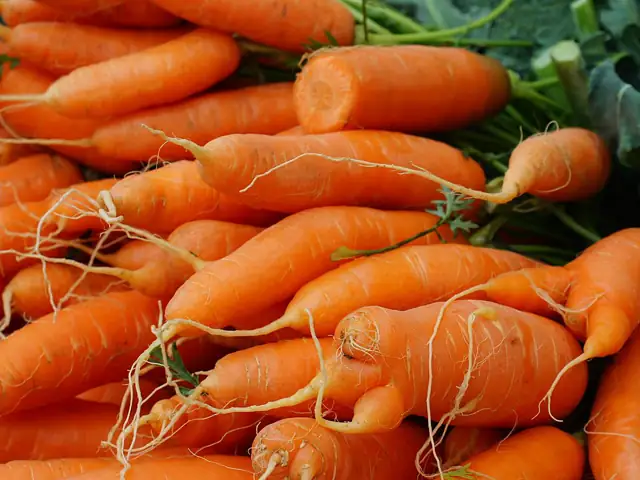
Carrot
Daucus carota
About it
- Kind
- Vegetables · Annual
- Family
- Apiaceae
- Hardiness zones
- Zones 2–11
- Frost
- Semi-hardy — takes a light frost
- Sun
- Full sun
- Spacing
- 2 in apart, rows 12 in
- Soil depth in a pot
- At least 10 in
- Soil pH
- 6–7
- Water
- About every 7 days
When to plant
- Sow outdoors
- Sow 2 weeks before the last frost
- Window
- Open for about 3 weeks
- Soil temperature
- Germinates from 40°F
- Ready
- About 70 days from sowing
Based on your last frost date. Outside the US, check local advice.
Varieties people grow
- Cosmic Purple— purple skin, orange flesh; spicy-sweet
- Danvers 126— tapered classic that copes with heavy soil
- Little Finger— small sweet baby carrot; good in pots
- Red Cored Chantenay— stubby root for heavy or shallow ground
- Scarlet Nantes— deep orange, sweet, almost coreless
Planting partners
No cited companion planting notes for Carrot yet.
Safety for pets and children
- Cats Listed as non-toxic to cats (NC State Extension)
- Dogs Listed as non-toxic to dogs (NC State Extension)
- Horses Listed as non-toxic to horses (NC State Extension)
- Children No information in our sources
Read from NC State Extension ↗.
"No information" means our sources do not say, not that the plant is harmless. A non-toxic listing is not a reason to let anyone eat a plant.
Pests and diseases
Cutworms Insect
What you'll see. Seedlings are chewed through at the soil line, and some cutworms feed on roots below ground.
What helps. Clear weeds and old plant debris before planting, since the moths lay eggs there. Search the soil within a foot of a damaged plant in the evening and remove the curled caterpillars.
Source: UMN Extension ↗
White mold Disease
Sclerotinia sclerotiorum
What you'll see. Stems turn pale, dry and brittle and the leaves above them wilt, and in damp weather fluffy white growth with small hard black bodies appears on the stems.
What helps. Space plants and water with drip or soaker hoses so they dry quickly. Remove infected plants as soon as you see them without shaking loose the black bodies, and compost them only in a pile that gets hot.
Source: UMN Extension ↗
Check the label and your local extension service before using any product.
Where this comes from
- direct sow weeks rel last frost cmg.extension.colostate.edu ↗ CSU #720 (Colorado) semi-hardy class, a class-wide figure: as early as 0-2 weeks before the last frost. UNH (New Hampshire) gives only a soil temperature (60°F)
- family npgsweb.ars-grin.gov ↗ GRIN page: Daucus carota L.
- frost hardiness cmg.extension.colostate.edu ↗ CSU #720 (Colorado) semi-hardy class lists carrots
- maturity counted from cmg.extension.colostate.edu ↗ Direct-seeded crop. Row's 70 days equals CSU #720 (Colorado) 70 (unmarked); NC State (North Carolina) Table 16-4 75-80 from seed
- maturity counted from NC State Extension ↗ Direct-seeded crop. Row's 70 days equals CSU #720 (Colorado) 70 (unmarked); NC State (North Carolina) Table 16-4 75-80 from seed
- min soil temp f cmg.extension.colostate.edu ↗ CSU #720 (Colorado) Table 1: carrots germination minimum 40°F. UNH (New Hampshire) says sow when soil warms to 60°F
- Most facts The Old Farmer's Almanac ↗ Backfilled by 0041. Pre-0041 rows recorded one source for the whole row; per-field attribution was never captured and is not invented here.
- sow window weeks cmg.extension.colostate.edu ↗ CSU #720 (Colorado) 0-2 weeks before last frost: weeks -2 to 0
- toxicity NC State Extension ↗ non_toxic for cat, dog, horse from its "non-toxic for" tags. Page matched to this row by its title (Daucus carota subsp. sativus, the garden carrot); not cited by the row before this batch.
- water frequency days NC State Extension ↗ NC State Gardener Handbook ch. 16, "Watering": "On average, vegetable gardens need 1 inch of water per week; provide only what is not supplied by rain." This is the handbook's general guidance for a vegetable garden, not a figure published for this crop.