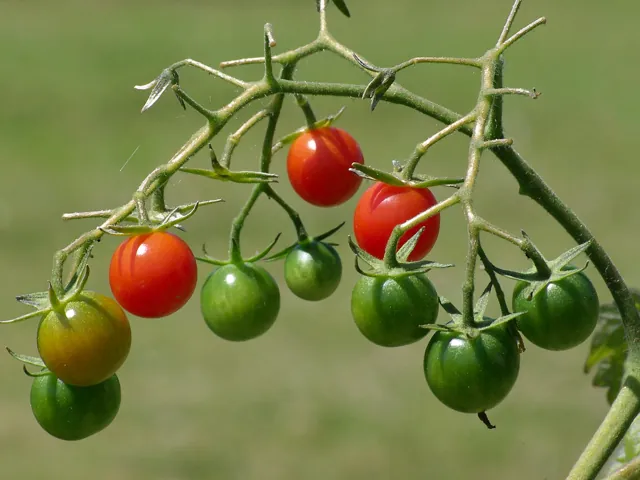
Cherry Tomato
Solanum lycopersicum
About it
- Kind
- Vegetables · Annual
- Family
- Solanaceae
- Hardiness zones
- Zones 3–11
- Frost
- Very tender — needs warm soil and nights
- Sun
- Full sun
- Spacing
- 24 in apart, rows 36 in
- Soil depth in a pot
- At least 12 in
- Soil pH
- 6–7
- Water
- About every 7 days
When to plant
- Start indoors
- 8 weeks before planting out
- Plant out
- Plant out 2 weeks after the last frost
- Soil temperature
- Germinates from 50°F
- Ready
- About 65 days from planting out
Based on your last frost date. Outside the US, check local advice.
Varieties people grow
- Black Cherry— purple-brown cherry with a rich, complex taste
- Juliet— red grape type; resists splitting after rain
- Sungold— small, very sweet, orange and early; skins split
- Supersweet 100— red cherries in long trusses; disease resistant
- Yellow Pear— little yellow pear-shaped heirloom; mild
Planting partners
What has been claimed about growing Cherry Tomato near other plants, grouped by how well it has been tested. Most companion planting advice has never been tested; the notes say which is which.
Tested in field trials
- With Basil Basil planted with tomatoes reduced thrips on the tomatoes in field and greenhouse studies. UMN Extension ↗
- With Marigold Marigolds planted with tomatoes reduced thrips on the tomatoes in field and greenhouse studies. UMN Extension ↗
Safety for pets and children
- Cats Listed as a problem for cats (NC State Extension) — Medium severity; in the leaves and stems; toxic principle: Toxic alkaloid tomatine and solanine
- Dogs Listed as a problem for dogs (NC State Extension) — Medium severity; in the leaves and stems; toxic principle: Toxic alkaloid tomatine and solanine
- Horses Listed as a problem for horses (NC State Extension) — Medium severity; in the leaves and stems; toxic principle: Toxic alkaloid tomatine and solanine
- Children Listed as a problem for children (NC State Extension) — Medium severity; in the leaves and stems; toxic principle: Toxic alkaloid tomatine and solanine
If a pet or child eats part of this plant, call your vet or poison control.
Read from NC State Extension ↗.
"No information" means our sources do not say, not that the plant is harmless. A non-toxic listing is not a reason to let anyone eat a plant.
Pests and diseases
Blossom-end rot Other problem
What you'll see. A flat tan to black patch can form on the bottom of the fruit, though cherry tomatoes get it less often than large slicing types.
What helps. Keep the soil evenly moist with regular watering and mulch, and fertilize only as a soil test recommends. Avoid digging close to the plant, where roots are easily damaged, and pick off affected fruit so the plant can put its effort into healthy ones.
Source: UMN Extension ↗
Early blight Disease
Alternaria tomatophila, Alternaria solani
What you'll see. Brown spots with target-like rings appear first on the lowest, oldest leaves, which yellow and drop. Stems and fruit can be spotted too.
What helps. Mulch the soil, water at the base rather than over the leaves, and stake and space plants so they dry quickly. Remove spotted leaves early, but never more than a third of the plant. Grow tomatoes and their relatives somewhere else for at least two years, and look for resistant varieties.
Source: UMN Extension ↗,UMN Extension (2) ↗
Late blight Disease
Phytophthora infestans
What you'll see. Large dark brown blotches with a grey-green edge spread fast over leaves and stems in cool, wet weather, and the fruit develops firm brown patches.
What helps. Water at the base in the morning, stake plants and space them so air moves between them. Plant where no tomatoes, potatoes, peppers or eggplants have grown for three to four years, and remove or bury the plants at the end of the season.
The source is written for Minnesota, where late blight arrives in some years and not others.
Source: UMN Extension ↗,UMN Extension (2) ↗
Tomato hornworm Insect
Manduca quinquemaculata
What you'll see. Large green caterpillars with a horn at the tail strip leaves from the top of the plant down and can chew into the fruit. Dark droppings on the leaves below are often the first sign.
What helps. Check plants twice a week in summer and pick the caterpillars off by hand. Leave any that carry small white cocoons, because the wasps inside kill hornworms. Pull nightshade-family weeds nearby, which feed them too.
Source: UMN Extension ↗,UMN Extension (2) ↗
Check the label and your local extension service before using any product.
Where this comes from
- family npgsweb.ars-grin.gov ↗ GRIN page: Solanum lycopersicum L.
- frost hardiness cmg.extension.colostate.edu ↗ CSU #720 (Colorado) lists tomato among very tender vegetables; applied to Cherry Tomato as a tomato
- maturity counted from cmg.extension.colostate.edu ↗ Row's 65 days equals CSU #720 (Colorado) Table 2's tomato 65T, where T means days from transplant
- min soil temp f cmg.extension.colostate.edu ↗ CSU #720 (Colorado) Table 2: tomato germination minimum 50°F at 4 in, 8 a.m.
- Most facts UMN Extension ↗ Backfilled by 0041. Pre-0041 rows recorded one source for the whole row; per-field attribution was never captured and is not invented here.
- toxicity NC State Extension ↗ toxic for cat, dog, horse, child from the page's "Problem for" listing. Severity, parts and principle are the page's poison characteristics for the whole plant. Page matched to this row by its recorded species; not cited by the row before this batch.
- transplant weeks rel last frost cmg.extension.colostate.edu ↗ UNH (New Hampshire) table: tomato 1-2 weeks after last frost; CSU #720 (Colorado) very tender class: typically 2+ weeks after. Tender crop, so the later week; no window, since CSU gives no end
- transplant weeks rel last frost extension.unh.edu ↗ UNH (New Hampshire) table: tomato 1-2 weeks after last frost; CSU #720 (Colorado) very tender class: typically 2+ weeks after. Tender crop, so the later week; no window, since CSU gives no end
- water frequency days UMN Extension ↗ UMN "Growing tomatoes": "One inch of rainfall or irrigation per week is ideal." A cherry tomato is the same species (Solanum lycopersicum); the page covers both.