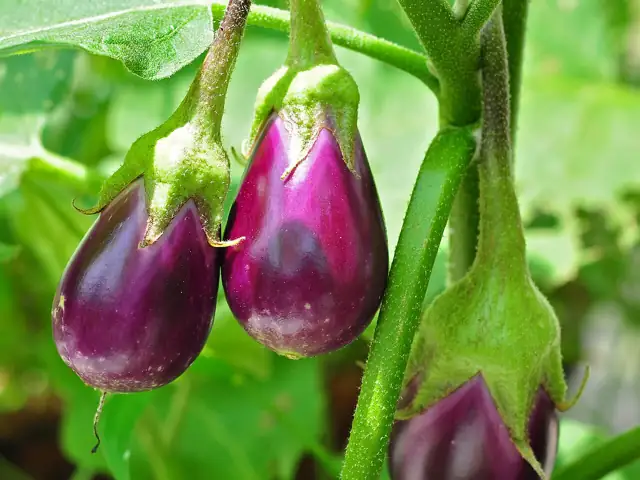
Eggplant
Solanum melongena
About it
- Kind
- Vegetables · Annual
- Family
- Solanaceae
- Hardiness zones
- Zones 3–11
- Frost
- Very tender — needs warm soil and nights
- Sun
- Full sun
- Spacing
- 18 in apart, rows 30 in
- Soil depth in a pot
- At least 12 in
- Soil pH
- 5.5–6.8
- Water
- About every 7 days
When to plant
- Start indoors
- 10 weeks before planting out
- Plant out
- Plant out 2 weeks after the last frost
- Window
- Open for about 2 weeks
- Soil temperature
- Germinates from 60°F
- Ready
- About 80 days from planting out
Based on your last frost date. Outside the US, check local advice.
Varieties people grow
- Black Beauty— the classic large glossy black eggplant
- Fairy Tale— small striped fruit on a compact, pot-sized plant
- Ichiban— long slender purple Japanese type; tender skin
- Listada de Gandia— Spanish heirloom striped purple and white
- Rosa Bianca— rounded lavender-white Italian heirloom; mild
Planting partners
No cited companion planting notes for Eggplant yet.
Safety for pets and children
- Cats Listed as a problem for cats (NC State Extension) — High severity; in the flowers, leaves, roots and stems; toxic principle: Alkaloids including solanine
- Dogs Listed as a problem for dogs (NC State Extension) — High severity; in the flowers, leaves, roots and stems; toxic principle: Alkaloids including solanine
- Horses Listed as a problem for horses (NC State Extension) — High severity; in the flowers, leaves, roots and stems; toxic principle: Alkaloids including solanine
- Children Listed as a problem for children (NC State Extension) — High severity; in the flowers, leaves, roots and stems; toxic principle: Alkaloids including solanine
If a pet or child eats part of this plant, call your vet or poison control.
Read from NC State Extension ↗.
"No information" means our sources do not say, not that the plant is harmless. A non-toxic listing is not a reason to let anyone eat a plant.
Pests and diseases
Colorado potato beetle Insect
Leptinotarsa decemlineata
What you'll see. Beetles and their larvae can gather on eggplant in large numbers and strip the leaves.
What helps. Handpick beetles and larvae into soapy water and crush the orange egg clusters under the leaves. Pull nightshade-family weeds and clean up the bed at the end of the season.
Source: UMN Extension ↗,UMN Extension (2) ↗
Cutworms Insect
What you'll see. Stems are chewed at the soil line, so young plants look snipped off.
What helps. Put a cardboard or foil collar around each transplant, pushed a little way into the soil. Clear weeds and old plant debris where the moths lay eggs, and search the soil near a damaged plant in the evening for the curled caterpillars.
Source: UMN Extension ↗,UMN Extension (2) ↗
Flea beetles Insect
What you'll see. Many small round holes in the leaves can weaken young plants and slow the fruit.
What helps. Cover young plants with row cover held up on hoops, since it cannot rest directly on eggplant, and clear weeds and old crop debris.
Source: UMN Extension ↗,UMN Extension (2) ↗
Twospotted spider mite Other problem
Tetranychus urticae
What you'll see. In hot, dry weather, tiny mites on the undersides of leaves leave them speckled, then bronzed or bleached, sometimes under fine webbing.
What helps. Keep plants well watered and mulched, because stressed plants are hit hardest. Knock mites off with a strong spray of water, which also breaks up their webbing.
Source: UMN Extension ↗,UMN Extension (2) ↗
Check the label and your local extension service before using any product.
Where this comes from
- family npgsweb.ars-grin.gov ↗ GRIN page: Solanum melongena L.
- frost hardiness cmg.extension.colostate.edu ↗ CSU #720 (Colorado) very tender class lists eggplant
- maturity counted from cmg.extension.colostate.edu ↗ Row's 80 days is nearest NC State (North Carolina) Table 16-4's T=90-95, far from S=150-155; CSU #720 (Colorado) counts eggplant from transplant (60T)
- maturity counted from NC State Extension ↗ Row's 80 days is nearest NC State (North Carolina) Table 16-4's T=90-95, far from S=150-155; CSU #720 (Colorado) counts eggplant from transplant (60T)
- min soil temp f cmg.extension.colostate.edu ↗ CSU #720 (Colorado) Table 2: eggplant germination minimum 60°F
- Most facts UMN Extension ↗ Backfilled by 0041. Pre-0041 rows recorded one source for the whole row; per-field attribution was never captured and is not invented here.
- sow window weeks extension.unh.edu ↗ UNH (New Hampshire) 2-3 weeks after last frost: weeks 2 to 3
- toxicity NC State Extension ↗ toxic for cat, dog, horse, child from the page's "Problem for" listing. Severity, parts and principle are the page's poison characteristics for the whole plant. Page matched to this row by its recorded species; not cited by the row before this batch.
- transplant weeks rel last frost cmg.extension.colostate.edu ↗ UNH (New Hampshire) table: eggplant 2-3 weeks after last frost; CSU #720 (Colorado) very tender class: typically 2+ weeks after. Agree on week 2
- transplant weeks rel last frost extension.unh.edu ↗ UNH (New Hampshire) table: eggplant 2-3 weeks after last frost; CSU #720 (Colorado) very tender class: typically 2+ weeks after. Agree on week 2
- water frequency days UMN Extension ↗ UMN "Growing eggplant": "If the plant does not receive one inch of rain weekly, soak the soil thoroughly at least once a week."