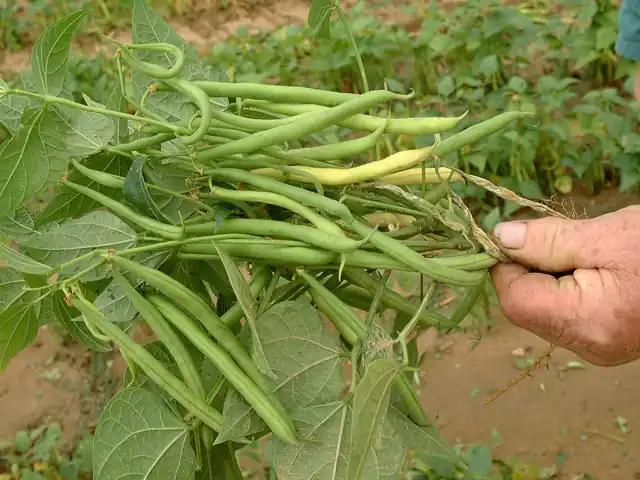
Green Beans
Phaseolus vulgaris
About it
- Kind
- Vegetables · Annual
- Family
- Fabaceae
- Hardiness zones
- Zones 3–11
- Frost
- Tender — damaged by frost
- Sun
- Full sun
- Spacing
- 4 in apart, rows 18 in
- Soil depth in a pot
- At least 8 in
- Soil pH
- 6–7.5
- Water
- About every 7 days
When to plant
- Sow outdoors
- Sow around the last frost
- Soil temperature
- Germinates from 55°F
- Ready
- About 55 days from sowing
- Sow again
- Every 14 days for a steady supply
Based on your last frost date. Outside the US, check local advice.
Varieties people grow
- Blue Lake Bush 274— bush bean with round stringless pods
- Contender— early bush bean; tolerates heat and mildew
- Dragon Tongue— bush wax bean, yellow pods streaked purple
- Kentucky Wonder— pole bean — needs a trellis; long stringless pods
- Provider— bush bean that comes up in cool soil
Planting partners
What has been claimed about growing Green Beans near other plants, grouped by how well it has been tested. Most companion planting advice has never been tested; the notes say which is which.
Tested in field trials
- With Pumpkin Corn, climbing beans and squash grown together produced more per area of land than each alone in field trials, partly because their roots feed at different depths. PubMed Central ↗
- With Sweet Corn Corn and climbing beans grown together produced more per area of land than either alone in field trials, partly because their roots feed at different depths. PubMed Central ↗
- With Zucchini Corn, climbing beans and squash grown together produced more per area of land than each alone in field trials, partly because their roots feed at different depths. PubMed Central ↗
Traditional practice, not tested
- With Pumpkin In the three sisters planting, beans add nitrogen and squash leaves shade the soil around them. UMN Extension ↗WSU Extension ↗
- With Sweet Corn In the three sisters planting, corn stalks hold up climbing beans and the beans add nitrogen. UMN Extension ↗WSU Extension ↗
- With Winter Squash In the three sisters planting, beans add nitrogen and squash leaves shade the soil around them. UMN Extension ↗WSU Extension ↗
Safety for pets and children
- Cats No information in our sources
- Dogs No information in our sources
- Horses No information in our sources
- Children No information in our sources
"No information" means our sources do not say, not that the plant is harmless. A non-toxic listing is not a reason to let anyone eat a plant.
Pests and diseases
Bean leaf beetle Insect
Cerotoma trifurcata
What you'll see. Small yellow-green to red beetles with a black triangle at the top of the wing covers chew round holes in the leaves and can scar pods, and seedlings suffer most.
What helps. Plant a little later in spring so seedlings miss the first beetles, and clean up leaf litter where adults spend the winter. Row cover with its edges sealed keeps them off, and beetles that drop when disturbed can be caught in a pail held underneath.
The source gives planting dates for Minnesota.
Source: UMN Extension ↗,UMN Extension (2) ↗
Cutworms Insect
What you'll see. Young bean plants are cut off at the soil line.
What helps. Clear weeds and old plant debris before planting, since the moths lay eggs there. Search the soil within a foot of a damaged plant in the evening and remove the curled caterpillars.
Source: UMN Extension ↗,UMN Extension (2) ↗
Twospotted spider mite Other problem
Tetranychus urticae
What you'll see. In hot, dry weather, tiny mites on the undersides of leaves leave them speckled, then bronzed or bleached, sometimes under fine webbing.
What helps. Keep plants well watered and mulched, because stressed plants are hit hardest. Knock mites off with a strong spray of water, which also breaks up their webbing.
Source: UMN Extension ↗,UMN Extension (2) ↗
White mold Disease
Sclerotinia sclerotiorum
What you'll see. Stems turn pale, dry and brittle and the leaves above them wilt, and in damp weather fluffy white growth with small hard black bodies appears on the stems.
What helps. Space plants and water with drip or soaker hoses so they dry quickly. Remove infected plants as soon as you see them without shaking loose the black bodies, and compost them only in a pile that gets hot.
Source: UMN Extension ↗,UMN Extension (2) ↗
Check the label and your local extension service before using any product.
Where this comes from
- direct sow weeks rel last frost cmg.extension.colostate.edu ↗ UNH (New Hampshire) table: bean direct seed after last frost; CSU #720 (Colorado) tender class: from seed around the date of the last frost. Agree
- direct sow weeks rel last frost extension.unh.edu ↗ UNH (New Hampshire) table: bean direct seed after last frost; CSU #720 (Colorado) tender class: from seed around the date of the last frost. Agree
- family npgsweb.ars-grin.gov ↗ GRIN page: Phaseolus vulgaris L.
- frost hardiness cmg.extension.colostate.edu ↗ CSU #720 (Colorado) tender class lists beans; lima beans are listed separately as very tender
- maturity counted from cmg.extension.colostate.edu ↗ Direct-seeded crop. Row's 55 days is within NC State (North Carolina) Table 16-4 snap/bush 50-55 (from seed) and near CSU #720 (Colorado) snap beans 60 (unmarked)
- maturity counted from NC State Extension ↗ Direct-seeded crop. Row's 55 days is within NC State (North Carolina) Table 16-4 snap/bush 50-55 (from seed) and near CSU #720 (Colorado) snap beans 60 (unmarked)
- min soil temp f cmg.extension.colostate.edu ↗ CSU #720 (Colorado) Table 2: snap beans 55°F, measured at 6 in rather than 4
- Most facts UMN Extension ↗ Backfilled by 0041. Pre-0041 rows recorded one source for the whole row; per-field attribution was never captured and is not invented here.
- succession interval days max extension.umd.edu ↗ Both sources give a single two-week interval (UMD Maryland, UMN Minnesota)
- succession interval days max UMN Extension ↗ Both sources give a single two-week interval (UMD Maryland, UMN Minnesota)
- succession interval days min extension.umd.edu ↗ UMD (Maryland): green beans at two-week intervals. UMN (Minnesota): bush beans every two weeks until early August; pole beans need no succession
- succession interval days min UMN Extension ↗ UMD (Maryland): green beans at two-week intervals. UMN (Minnesota): bush beans every two weeks until early August; pole beans need no succession
- water frequency days UMN Extension ↗ UMN "Growing beans": "One inch of rainfall per week is good." and beans "grown in sandy soils will require watering often."