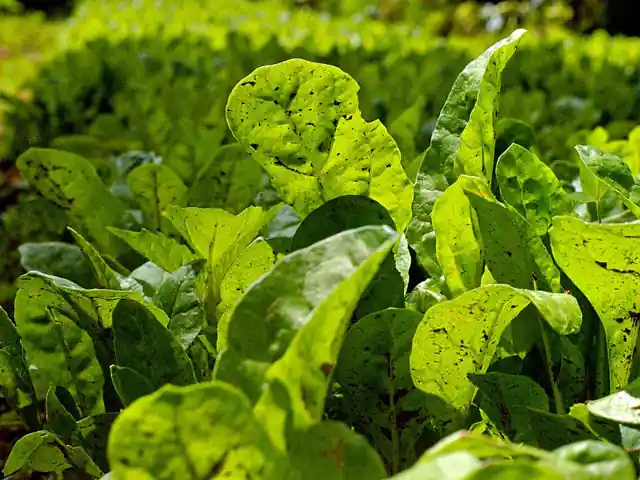
Spinach
Spinacia oleracea
About it
- Kind
- Vegetables · Annual
- Family
- Chenopodiaceae
- Hardiness zones
- Zones 2–11
- Frost
- Hardy — takes a hard frost
- Sun
- Part shade
- Spacing
- 3 in apart, rows 12 in
- Soil depth in a pot
- At least 6 in
- Soil pH
- 6.5–7.5
- Water
- About every 7 days
When to plant
- Start indoors
- 6 weeks before planting out
- Plant out
- Plant out 6 weeks before the last frost
- Sow outdoors
- Sow 4 weeks before the last frost
- Soil temperature
- Germinates from 40°F
- Ready
- About 45 days from sowing
- Sow again
- Every 7–14 days for a steady supply
Based on your last frost date. Outside the US, check local advice.
Varieties people grow
- Bloomsdale Long Standing— crinkled heirloom; overwinters well
- Corvair— smooth leaf with strong downy mildew resistance
- Giant Winter— very hardy semi-crinkled type for overwintering
- Space— smooth leaf for any season; mildew resistant
Planting partners
No cited companion planting notes for Spinach yet.
Safety for pets and children
- Cats No information in our sources
- Dogs No information in our sources
- Horses No information in our sources
- Children No information in our sources
"No information" means our sources do not say, not that the plant is harmless. A non-toxic listing is not a reason to let anyone eat a plant.
Pests and diseases
Aphids Insect
What you'll see. Small soft-bodied green peach aphids feed on the leaves, which can curl and yellow when numbers are high.
What helps. Knock aphids off with a strong spray of water and pull weeds that host them. Lady beetles, lacewings and other natural enemies often bring numbers down on their own, so check again before doing more.
Source: UMN Extension ↗
Flea beetles Insect
What you'll see. Beetles chew small holes in the leaves, and seedlings are hurt most.
What helps. Cover young plants with row cover, and clear weeds and old crop debris where the beetles spend the winter. Sowing a little later in the season lets plants grow quickly past the worst of the feeding.
Source: UMN Extension ↗
Leafminers Insect
What you'll see. Larvae feeding inside the leaves leave pale, irregular blotches that later turn brown, spoiling the harvest.
What helps. Pick off and destroy mined leaves while the damage is small, and pull weeds such as lambsquarters. Fine netting keeps the flies off, but only in a bed that had no leafminers the year before.
Source: UMN Extension ↗
Check the label and your local extension service before using any product.
Where this comes from
- direct sow weeks rel last frost cmg.extension.colostate.edu ↗ CSU #720 (Colorado) hardy class, a class-wide figure: as early as 2-4 weeks before the last frost; Table 1 gives spinach no transplant age, i.e. sown direct
- family npgsweb.ars-grin.gov ↗ GRIN page: Spinacia oleracea L.. GRIN keeps Chenopodiaceae separate; APG IV merges it into Amaranthaceae
- frost hardiness cmg.extension.colostate.edu ↗ CSU #720 (Colorado) hardy class lists spinach
- indoor start weeks extension.unh.edu ↗ UNH (New Hampshire) table: 4-6 weeks from seed to transplant; the top of the range
- maturity counted from cmg.extension.colostate.edu ↗ Row's 45 days sits between CSU #720 (Colorado) 40 (unmarked) and NC State (North Carolina) Table 16-4's 50-60 (from seed)
- maturity counted from NC State Extension ↗ Row's 45 days sits between CSU #720 (Colorado) 40 (unmarked) and NC State (North Carolina) Table 16-4's 50-60 (from seed)
- min soil temp f cmg.extension.colostate.edu ↗ CSU #720 (Colorado) Table 1: spinach germination minimum 40°F
- Most facts The Old Farmer's Almanac ↗ Backfilled by 0041. Pre-0041 rows recorded one source for the whole row; per-field attribution was never captured and is not invented here.
- succession interval days max WVU Extension ↗ WVU (West Virginia): seven to 14 days apart
- succession interval days min WVU Extension ↗ WVU (West Virginia): stagger plantings seven to 14 days apart; names spinach
- transplant weeks rel last frost extension.unh.edu ↗ UNH (New Hampshire) table: spinach 4-6 weeks from seed, set out 3-6 weeks before last frost; the earlier week. No window because the row also has a direct-sow week
- water frequency days NC State Extension ↗ NC State Gardener Handbook ch. 16, "Watering": "On average, vegetable gardens need 1 inch of water per week; provide only what is not supplied by rain." This is the handbook's general guidance for a vegetable garden, not a figure published for this crop.