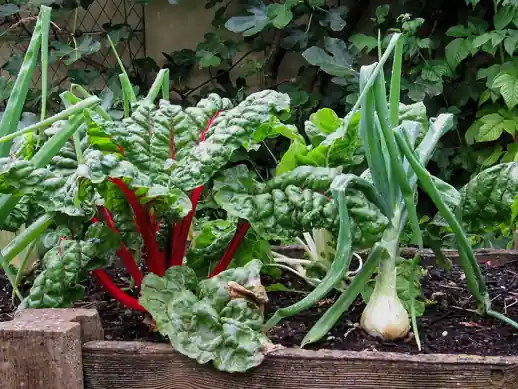
Swiss Chard
Beta vulgaris cicla
About it
- Kind
- Vegetables · Annual
- Family
- Chenopodiaceae
- Hardiness zones
- Zones 2–11
- Frost
- Semi-hardy — takes a light frost
- Sun
- Part shade
- Spacing
- 6 in apart, rows 18 in
- Soil depth in a pot
- At least 8 in
- Soil pH
- 6–7
- Water
- About every 7 days
When to plant
- Start indoors
- 6 weeks before planting out
- Plant out
- Plant out 2 weeks before the last frost
- Sow outdoors
- Sow 4 weeks before the last frost
- Soil temperature
- Germinates from 40°F
- Ready
- About 60 days from sowing
Based on your last frost date. Outside the US, check local advice.
Varieties people grow
- Bright Lights— mixed pink, gold and orange stems
- Fordhook Giant— the standard white-stemmed green chard
- Lucullus— old green and white chard; the one Fordhook came from
- Ruby Red— deep red stems; also sold as Rhubarb Chard
Planting partners
No cited companion planting notes for Swiss Chard yet.
Safety for pets and children
- Cats No information in our sources
- Dogs No information in our sources
- Horses No information in our sources
- Children No information in our sources
"No information" means our sources do not say, not that the plant is harmless. A non-toxic listing is not a reason to let anyone eat a plant.
Pests and diseases
Leafminers Insect
What you'll see. Larvae feeding inside the leaves leave pale, irregular blotches that later turn brown.
What helps. Pick off and destroy mined leaves while the damage is small, and pull weeds such as lambsquarters. Fine netting keeps the flies off, but only in a bed that had no leafminers the year before.
Source: UMN Extension ↗
Check the label and your local extension service before using any product.
Where this comes from
- direct sow weeks rel last frost extension.unh.edu ↗ UNH (New Hampshire) table: Swiss chard direct seed 4 weeks before last frost. CSU #720 (Colorado) semi-hardy class says 0-2 weeks before; the crop-specific UNH figure is kept
- family npgsweb.ars-grin.gov ↗ GRIN page: Beta vulgaris L. (the species page; chard is Beta vulgaris subsp. vulgaris, leaf beet group). GRIN keeps Chenopodiaceae separate; APG IV merges it into Amaranthaceae
- frost hardiness cmg.extension.colostate.edu ↗ CSU #720 (Colorado) semi-hardy class lists Swiss chard
- indoor start weeks extension.unh.edu ↗ UNH (New Hampshire) table: 4-6 weeks from seed to transplant; the top of the range
- maturity counted from cmg.extension.colostate.edu ↗ Row's 60 days equals CSU #720 (Colorado) Table 1's unmarked 60 and NC State (North Carolina) Table 16-4's S=60-70 (T=32-42)
- maturity counted from NC State Extension ↗ Row's 60 days equals CSU #720 (Colorado) Table 1's unmarked 60 and NC State (North Carolina) Table 16-4's S=60-70 (T=32-42)
- min soil temp f cmg.extension.colostate.edu ↗ CSU #720 (Colorado) Table 1: Swiss chard germination minimum 40°F
- Most facts The Old Farmer's Almanac ↗ Backfilled by 0041. Pre-0041 rows recorded one source for the whole row; per-field attribution was never captured and is not invented here.
- transplant weeks rel last frost extension.unh.edu ↗ UNH (New Hampshire) table: Swiss chard transplants 2 weeks before last frost
- water frequency days NC State Extension ↗ NC State Gardener Handbook ch. 16, "Watering": "On average, vegetable gardens need 1 inch of water per week; provide only what is not supplied by rain." This is the handbook's general guidance for a vegetable garden, not a figure published for this crop.