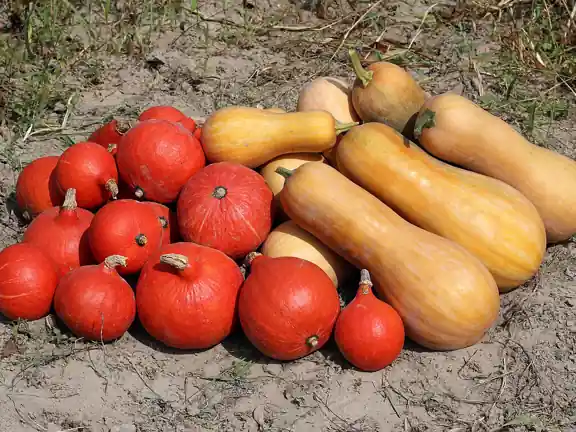
Winter Squash
Cucurbita maxima
About it
- Kind
- Vegetables · Annual
- Family
- Cucurbitaceae
- Hardiness zones
- Zones 3–11
- Frost
- Very tender — needs warm soil and nights
- Sun
- Full sun
- Spacing
- 24 in apart, rows 72 in
- Soil depth in a pot
- At least 18 in
- Soil pH
- 6–7.5
- Water
- About every 7 days
When to plant
- Start indoors
- 3 weeks before planting out
- Plant out
- Plant out 2 weeks after the last frost
- Sow outdoors
- Sow 2 weeks after the last frost
- Soil temperature
- Germinates from 60°F
- Ready
- About 100 days from sowing
Based on your last frost date. Outside the US, check local advice.
Varieties people grow
- Burgess Buttercup— the original buttercup; sweet dense flesh
- Bush Delicata— striped delicata on a bush, not a long vine
- Table Queen— the classic ribbed green acorn squash
- Vegetable Spaghetti— yellow squash whose flesh forks into strands
- Waltham Butternut— the standard tan butternut; keeps well
Planting partners
What has been claimed about growing Winter Squash near other plants, grouped by how well it has been tested. Most companion planting advice has never been tested; the notes say which is which.
Tested in field trials
- With Marigold In an Iowa study, marigolds planted with squash reduced damage from squash bugs and cucumber beetles. UMN Extension ↗
- With Nasturtium Nasturtiums planted with squash reduced squash bugs, and in an Iowa study reduced squash bug and cucumber beetle damage. UMN Extension ↗
Traditional practice, not tested
- With Green Beans In the three sisters planting, beans add nitrogen and squash leaves shade the soil around them. UMN Extension ↗WSU Extension ↗
- With Sweet Corn In the three sisters planting, squash leaves shade the soil around the corn and the squash is said to put raccoons off the corn. UMN Extension ↗WSU Extension ↗
Safety for pets and children
- Cats Listed as non-toxic to cats (NC State Extension)
- Dogs Listed as non-toxic to dogs (NC State Extension)
- Horses Listed as non-toxic to horses (NC State Extension)
- Children No information in our sources
Read from NC State Extension ↗.
"No information" means our sources do not say, not that the plant is harmless. A non-toxic listing is not a reason to let anyone eat a plant.
Pests and diseases
Powdery mildew Disease
What you'll see. White powdery spots appear on the leaves in mid to late summer and can spread until whole leaves are covered, leaving fewer and smaller fruit.
What helps. Choose resistant varieties, and give plants room and keep weeds down so air moves through the vines. Avoid heavy nitrogen feeding.
Source: UMN Extension ↗
Squash bug Insect
Anasa tristis
What you'll see. Flat grey-brown bugs and their nymphs feed in groups under the leaves, leaving yellow spots that turn brown, and young plants can wilt and die.
What helps. Crush the bronze egg clusters on leaf undersides and drop bugs into a pail of soapy water, and clear plant debris in fall. Butternut and buttercup squash tolerate squash bug feeding better than other kinds.
Source: UMN Extension ↗
Squash vine borer Insect
What you'll see. A plant wilts, first in strong sun and then for good, and holes near the base of the stem are packed with sawdust-like droppings from the larvae feeding inside.
What helps. Cover plants with row cover while the moths are laying eggs, take it off at flowering, and do not cover a bed where squash grew last year. Butternut squash is attacked less than Hubbard or acorn types.
Timings in the source are for Minnesota, where the moths fly from late June through July.
Source: NC State Extension ↗,UMN Extension ↗
Striped cucumber beetle Insect
Acalymma vittatum
What you'll see. Striped beetles chew the leaves of seedlings; winter squash tolerates a lot of feeding once it has a few true leaves.
What helps. Cover young plants with row cover and take it off when flowers open so bees can reach them. Clear weeds, and remove garden debris in fall where the beetles spend the winter.
Source: UMN Extension ↗
Check the label and your local extension service before using any product.
Where this comes from
- direct sow weeks rel last frost cmg.extension.colostate.edu ↗ CSU #720 (Colorado) very tender class, a class-wide figure: typically 2+ weeks after the last frost. UNH (New Hampshire) times direct seeding by soil warming to 70°F instead
- family npgsweb.ars-grin.gov ↗ GRIN page: Cucurbita maxima Duchesne
- frost hardiness cmg.extension.colostate.edu ↗ CSU #720 (Colorado) very tender class lists winter squash
- indoor start weeks cmg.extension.colostate.edu ↗ UNH (New Hampshire) 3-4 weeks, CSU #720 (Colorado) transplant age 2-3: 3 is in both
- indoor start weeks extension.unh.edu ↗ UNH (New Hampshire) 3-4 weeks, CSU #720 (Colorado) transplant age 2-3: 3 is in both
- maturity counted from cmg.extension.colostate.edu ↗ Row's 100 days equals CSU #720 (Colorado) Table 2 winter squash 100 (unmarked); NC State (North Carolina) Table 16-4 S=70-95, T=42-67
- maturity counted from NC State Extension ↗ Row's 100 days equals CSU #720 (Colorado) Table 2 winter squash 100 (unmarked); NC State (North Carolina) Table 16-4 S=70-95, T=42-67
- min soil temp f cmg.extension.colostate.edu ↗ CSU #720 (Colorado) Table 2: winter squash germination minimum 60°F. UNH (New Hampshire) says sow when soil warms to 70°F
- Most facts The Old Farmer's Almanac ↗ Backfilled by 0041. Pre-0041 rows recorded one source for the whole row; per-field attribution was never captured and is not invented here.
- toxicity NC State Extension ↗ non_toxic for cat, dog, horse from its "non-toxic for" tags. Page matched to this row by its recorded species; not cited by the row before this batch.
- transplant weeks rel last frost cmg.extension.colostate.edu ↗ UNH (New Hampshire) table: winter squash transplants 2 weeks after last frost; CSU #720 (Colorado) very tender class: typically 2+ weeks after. Agree
- transplant weeks rel last frost extension.unh.edu ↗ UNH (New Hampshire) table: winter squash transplants 2 weeks after last frost; CSU #720 (Colorado) very tender class: typically 2+ weeks after. Agree
- water frequency days NC State Extension ↗ NC State Gardener Handbook ch. 16, "Watering": "On average, vegetable gardens need 1 inch of water per week; provide only what is not supplied by rain." This is the handbook's general guidance for a vegetable garden, not a figure published for this crop.